The Making of This Book
How this book was conceived, written, checked, produced and published, without giving up any of my intellectual standards.
The first idea for this book goes back to the moment when, like many others, I realized that artificial intelligence could do the thing I love most faster than I can: writing. I did not say better than me. I said faster. Writing is labour, intellectual and cognitive of course, but also craft and handwork: fingers on the keyboard or on paper, a little like the work of a painter, who knows their pigments and lays down the layers one by one on the canvas. I wanted to run an experiment, to see what it is to write with a new instrument said to be so powerful. Do I really need, I asked myself, to write out every determiner myself, by hand, to adjust every conjugation, to form the letters of every preposition, every relative pronoun, every coordinating conjunction?
I understood later what is happening. An author who writes with AI is like a painter who makes colour with photography: they no longer have to manufacture each pigment or lay it on the canvas by hand, but they go on thinking through and about the image they are photographing, considering the light, choosing the key colours they want to render, the framing, the sharpness, the depth of field, not to mention all the later corrections they will make with editing software. With writing it is the same. I am the one, and I will always be the one — the author — who conceives the text, works out the idea, weighs the structure and the argument, chooses the key concepts, validates the choice of every word, decides on the style, the tone, the register, and who makes the corrections in the final text. For that, I do not need to shape each letter myself or to compose the words by hand, one letter after another. My value lies elsewhere — and so does my pleasure. The instrument changes with the times; it can never be the author. The author endures through the ages; the author can only be human. Instruments have powers, but they have no identity, no intention, no signature.
Why a lexicon? Because I love dictionaries, and I have just written and edited one on design, with the help of nearly a hundred colleagues. Why artificial intelligence? Because I am the author of Being and the Screen: How the Digital Changes Perception (MIT Press), and because the “AI revolution” reproduces exactly the phenomenon I described for the “digital revolution”: any new technology that takes hold systemically ends up being naturalized. AI lexicons already exist, of course. I wanted to bring something different. And so came the idea that governs the whole book: a lexicon presented not in alphabetical order but in chapters, like an essay that tells a story, from the most theoretical to the most applied.
At first, I was tempted to go fast. To let AI produce, and to head straight for the result. I could not. My name on a cover has always meant the same thing, for all my books: the commitment of my intellectual and academic responsibility, the endorsement of the content word for word and, of course, my author’s signature — with the family name it carries. So it very quickly became unthinkable to let AI run without my controlling everything. I built my writing process accordingly, so as to make AI my cognitive and editorial assistant, in every one of my phases of work.
First, I worked out an angle, a title, and asked it to challenge me and assess me. I defined a template for the entries, and asked it, iteratively, to apply it. I had it write first drafts, which I systematically modified, sometimes a great deal, sometimes barely. I then had those drafts reread and criticized by the machine itself, which found, after the fact, problems in what it had generated. Nothing that might strike me as intelligent in its answers was intelligent in itself: when there was intelligence in them, it was because I was the one seeing it. I decided to ignore whole swaths of its answers; I did not even read everything it replied; I selected only what I found relevant, the way I read a book, taking from its contents what interests me.
And then, of course, there was the checking. I have never corrected and verified a manuscript so much. I checked every technical claim against outside sources: encyclopedias, dictionaries, scholarly articles, the websites of digital industry companies, cutting-edge posts on social media… Very often I replaced the examples it proposed with others I found more apt. I rewrote any number of turns of phrase I did not like, either because they did not sound like me, or because they smacked too much of the style of a probabilistic machine (generalizing, abstract, blandly accurate, without personality).
When I had finished the manuscript, I did what any good academic does: I asked a peer for a critical reading, and for that I chose Professor Marcello Vitali-Rosati, not because he is a friend, but because everyone knows that the way he looks at artificial intelligence is critical and uncompromising, free of any indulgence. I then had a series of corrections to make. When I again believed the final manuscript was finished, I had it analyzed by an artificial intelligence system other than the one used at the outset. I asked it to run systematic checks on every aspect of the manuscript, sometimes with several agents running in parallel: spelling and grammar, typos, accuracy (are there errors?), consistency (do I contradict myself?), terminological stability (do I use the same terms everywhere for the same things?), the makeup of the file, the page numbers, the styles, and so on. I still had to make many corrections, because inconsistencies kept appearing that I had not seen before.
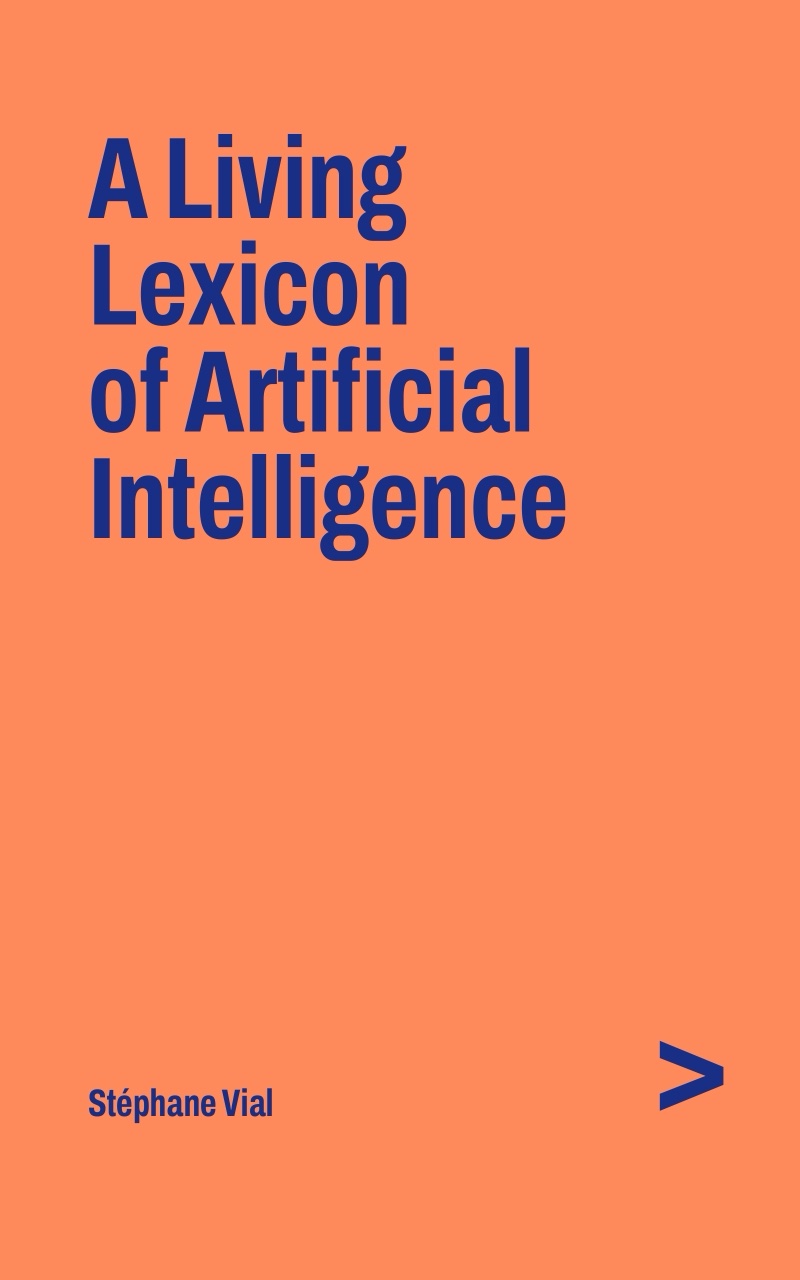
Then something unexpected happened. With the manuscript finished, I discovered that I could keep going: design the cover and calculate the width of the spine; obtain the ISBNs and generate the matching barcodes; generate the index and check the ninety-one cross-references automatically; set a price grid across eight marketplaces; submit, correct the proofs, publish, promote. What a publishing house does, with its many professions and its years of know-how, I learned and carried out alone, in a few weeks. I draw no triumphant lesson from it: it was a great deal of work. Working this way demands constant vigilance.
The paradox is that producing this book took me longer than expected, but less time than a conventional publishing process would have. I had to face a few technical costs, and to develop an over-checking mindset. Choosing self-publishing also has a social cost: doing everything yourself means giving up bookstore sales representation, conventional distribution, an editorial team whose worth I know. In exchange, I gained control of the chain and total freedom, indispensable for carrying out such an experiment.
Such is the story of this book about AI, written with AI.
Read also
My statement on the use of artificial intelligence
How to cite this text
Vial, S. (2026). The making of this book. In A Living Lexicon of Artificial Intelligence (pp. 131–134). Stéphane Vial, publisher, Montréal.